
Shrink Tunnel Machine Selection: Economy vs Energy-Saving for Tape Lines
A finished tape roll that leaves your factory unwrapped picks up dust, rubs against its neighbours, and reaches the distributor with scuffed edges and no tamper seal. That is a return waiting to happen. A shrink tunnel is the heat step that pulls the film tight around the roll after the wrapper has sleeved it. The choice between an economy tunnel and an energy-saving one decides how much you pay for power and how warm your floor stays over the next seven years. This article compares the two tunnel configurations we build, the SD-4020 and the SD-4522, and shows where each fits on a tape packing line so you can size it before you buy.
What Is a Shrink Tunnel Machine?
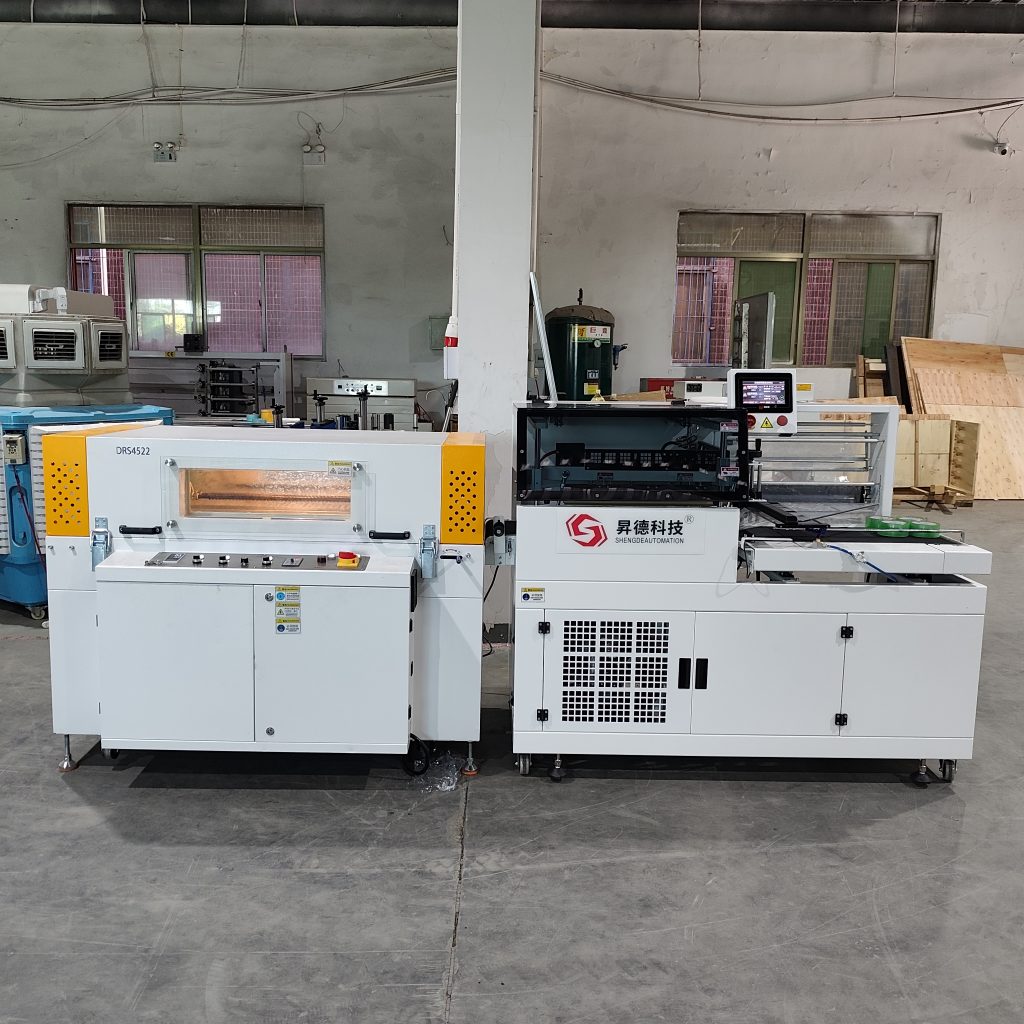
A shrink tunnel passes hot air through a chamber so the loose film sleeve around a roll shrinks tight to the roll surface. It sits after the wrapping or sleeving step, not before it. Without the tunnel you have film hanging loose; with it you get a dust-proof, scuff-proof, tamper-evident pack that stacks into a clean column. Both our tunnels use hot-air internal circulation, not steam, which keeps the mechanism simple and the maintenance predictable. The SD-4522 energy-saving tunnel and the SD-4020 economy tunnel are the same machine in two cost configurations, which is the part buyers miss.
Types of Shrink Tunnel Machines
We build one tunnel design in two configurations. The difference is not speed or film type. It is how the machine converts power into heat and how much of that heat stays inside the chamber.
SD-4020: Economy Model
Best for: buyers whose first priority is the lowest purchase price and who run in a space where floor heat is not a concern.
Core difference: single-frequency conversion, no insulation cotton, stable running power around 9 kW.
What supports it:
- Simple single-freq drive, fewer components to service
- Same hot-air internal circulation as the SD-4522
- Runs POF, PVC, and PE film
- Small footprint, low purchase cost
Choose this when: budget is the deciding factor and your line runs in a ventilated area where the warmer surroundings around the machine will not bother operators.
SD-4522: Energy-Saving Model
Best for: buyers who run two shifts and want lower power draw and a cooler floor over the life of the machine.
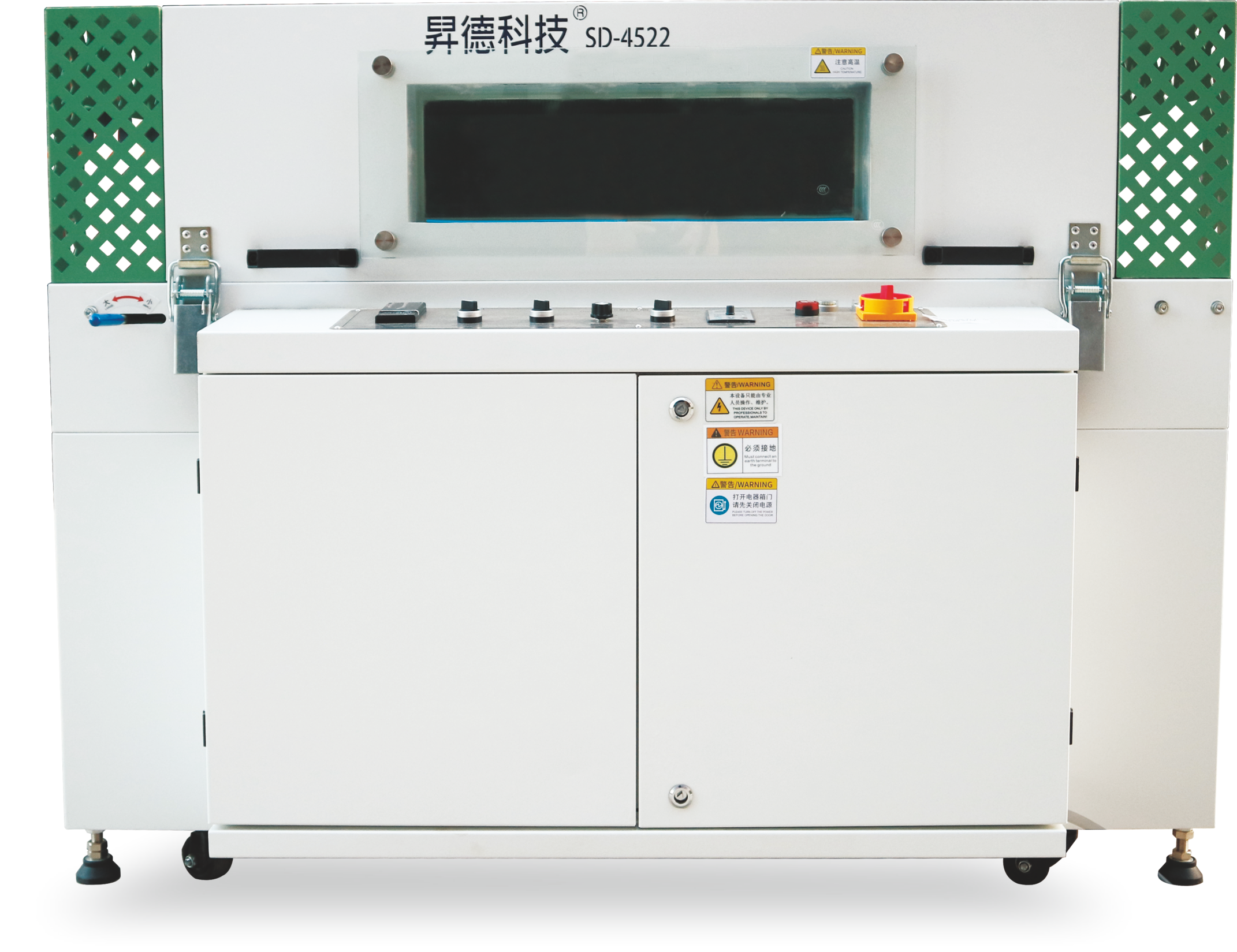
Core difference: dual-frequency conversion plus added insulation cotton, stable running power around 6 kW, and the area around the machine stays noticeably cooler.
What supports it:
- Dual-frequency drive holds temperature steady under load changes
- Insulation cotton keeps heat in the chamber, not on the floor
- Same hot-air internal circulation, same film compatibility
- Whole upgraded version with the energy-saving build as standard
Choose this when: you pack continuously, energy cost is a line item you watch, or operator comfort near the tunnel matters in your plant.
Where the Shrink Tunnel Fits on the Line
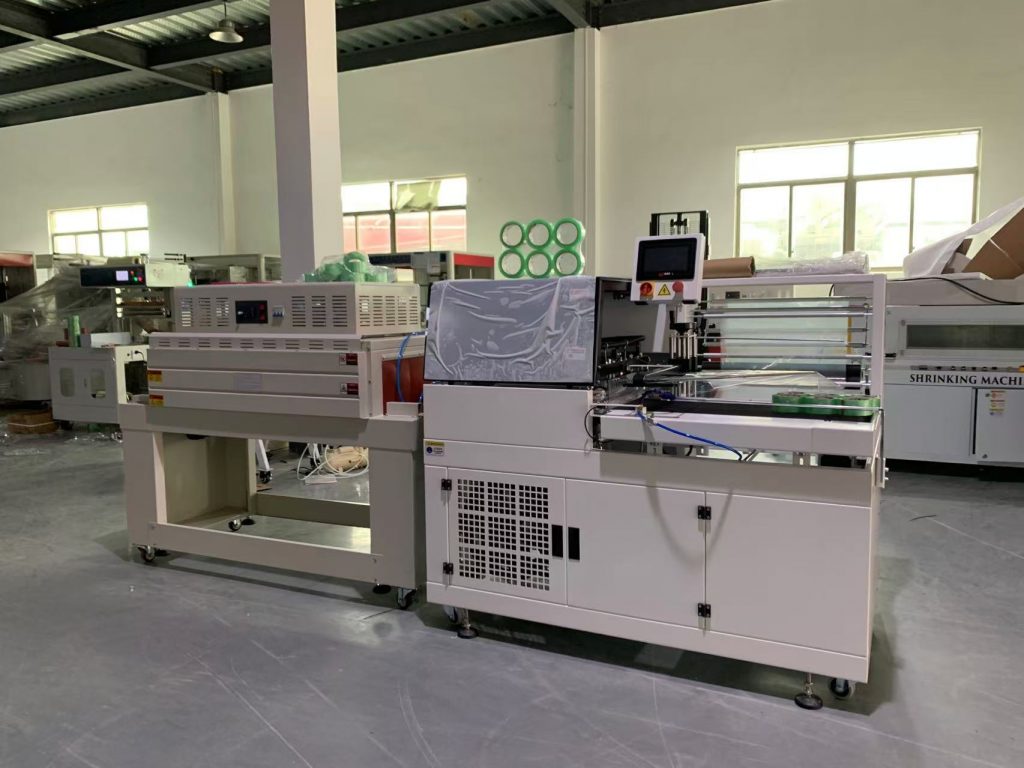
A tape packing line runs in this order: paper core preparation with the SD-F001 paper core cutter, then rewinding and slitting, then single- or multi-roll wrapping and shrink with the SD-60SS, SD-77HM, SD-920HM, or SD-TB1020 cuff pack machine, then the shrink tunnel closes the film. After the tunnel come labeling, case erecting and sealing, and palletizing.
The tunnel is the last heat step in the packaging cell. Three of our packing units pair with either tunnel: the SD-1060 column sleeve packer, the SD-BL450 L-type sealer, and the SD-TB1020 cuff pack machine. SD-4522 can be swapped for the economy SD-4020 depending on budget without changing the wrapper upstream.
SD-4020 vs SD-4522: The Real Trade-off
| Dimension | SD-4020 | SD-4522 |
|---|---|---|
| Position | Economy | Energy-saving |
| Frequency conversion | Single | Dual |
| Stable running power | ~9 kW | ~6 kW |
| Insulation cotton | No | Yes |
| Temperature around machine | Higher | Lower |
| Purchase price | Lower | Higher |
The two tunnels run the same film at the same line speed. The trade-off is running cost and floor temperature, not throughput. Over two shifts the SD-4522 draws roughly 3 kW less at stable running, and the insulation keeps the heat off your operators. The SD-4020 costs less up front and is the right call when the purchase price is the constraint and the line sits in a ventilated space. Buyers who pack all day feel the power and comfort gap within the first month, which is why we offer both instead of one.
Annual Electricity Cost: What the 3 kW Gap Costs
The 9 kW against 6 kW split is the whole reason the two tunnels exist. Power is a yearly bill, not a one-time line. To size it, take a two-shift tape line running about 4,000 hours a year (roughly 250 working days at 16 hours). Substitute your own hours and rate; the formula holds.
| SD-4020 | SD-4522 | Gap | |
|---|---|---|---|
| Stable running power | 9 kW | 6 kW | 3 kW |
| Annual energy at 4,000 h | 36,000 kWh | 24,000 kWh | 12,000 kWh |
| Annual cost at $0.12/kWh | $4,320 | $2,880 | $1,440 |
| 7-year energy cost | $30,240 | $20,160 | $10,080 |
At a $0.12/kWh industrial rate the energy-saving SD-4522 saves about $1,440 a year against the SD-4020. In markets with higher power cost the gap widens: at $0.25/kWh the yearly saving passes $3,000. Over the 7-year life we build these tunnels for, the energy gap reaches roughly 84,000 kWh, which at typical rates recovers a large share of the SD-4522’s higher purchase price. The economy SD-4020 still wins when the purchase price is the hard constraint and the line runs where floor heat is not an issue.
Tunnel Chamber Size: The Dimension That Actually Decides Fit
When you size a shrink tunnel, the chamber opening matters more than the configuration. Both the SD-4522 and the SD-4020 use the same selection rule: the chamber must clear the width and height of your largest finished pack. The tunnel is flexible and pairs with most of our wrappers upstream, so the model does not lock you to a pack size. Your product’s width and height decide the chamber you need.
Chamber dimensions:
| SD-4522 | SD-4020 | |
|---|---|---|
| Chamber (L × W × H) | 1200 × 450 × 220 mm | 1000 × 350 × 150 mm |
The SD-4522 chamber is the larger of the two, suited to bigger tape columns and taller multi-roll packs. The SD-4020 chamber fits standard single-roll and smaller multi-roll packs.
How to size it: measure the width and height of your finished pack with film on. If both clear the chamber opening with margin, the tunnel fits as standard. If your product is larger, send us your product dimensions and we size and build a customized chamber for it. Most of our tunnels are built to the order anyway, so a non-standard pack is a specification we work from, not a problem we pass back to you.
How to Choose the Right Shrink Tunnel
The six points below settle the technical fit. They are about the machine, not the contract.
1. Match the tunnel to the wrapper upstream. The SD-1060, SD-BL450, and SD-TB1020 all pair with either tunnel. Pick the tunnel after you fix the wrapper.
2. State your roll diameter and pack height against the chamber. The SD-4522 chamber clears 450 mm wide by 220 mm high; the SD-4020 clears 350 mm wide by 150 mm high (both are 1200 mm and 1000 mm long). If your largest pack fits with margin, pick the model on power and price. If it does not, send the dimensions and we size a custom chamber. See the chamber-size section above.
3. Check daily output. The tunnel keeps pace with the wrapper. The bottleneck on most lines is the wrapping station, not the heat step.
4. Name your film. POF, PVC, and PE all run. Set the temperature per film; 15 to 25 micron film is common for tape rolls.
5. Weigh floor space and airflow. The insulated SD-4522 keeps the surrounding area cooler, which matters in a tight packing cell.
6. Budget the power draw. Stable running is ~9 kW on the SD-4020 and ~6 kW on the SD-4522. Multiply by your shift count to see the yearly gap.
The six steps above settle the technical fit. The questions below settle the commercial terms.
Questions to Ask Before You Sign
- Who installs it? We run video-guided remote installation. The machine is up the same day and in production after 1 to 3 days of commissioning. No costly on-site trip, no waiting on a service engineer to fly in.
- Does it ship with CE certification and light-curtain guarding? For export this is non-negotiable. Both tunnels are built to CE with light-curtain guarding as standard.
- What is the real lifespan under two shifts? We build for 7-year reliable operation under two-shift production. Ask any supplier for the same number in writing.
- Can you troubleshoot it remotely? Both tunnels carry wireless remote APP monitoring and system upgrade, so we can diagnose from our side instead of shipping a fault blind.
- How do you handle diameter and height changeover? Modular molds swap for different diameters and heights. Give us your product range and we confirm the mold set.
These are the standards we build to at Shengde.
FAQ
Do I need a separate shrink tunnel if my wrapper already sleeves film?
The wrapper puts the loose film sleeve on the roll. The tunnel is what shrinks it tight. Without the tunnel you ship rolls with film that slides and tears. On our lines the tunnel is a paired unit after the SD-1060, SD-BL450, or SD-TB1020, not built into the wrapper.
What film thickness works in the tunnel?
Film from 15 to 25 micron is common for tape rolls. POF, PVC, and PE all run; set the tunnel temperature to the film, not to a fixed number. This is a consumable choice, not a machine limit.
How much does a shrink tunnel machine cost?
It depends on the configuration and your pack size. Send your roll diameter, finished pack width, daily output, and film type, and we return a sized quote. We do not publish a price list because every chamber is sized to the order.
Can one tunnel serve both single-roll and multi-roll lines?
Yes, if the chamber is sized for your larger pack. Both the SD-4020 and SD-4522 handle single-roll and multi-roll packs; the wrapper upstream decides the pack format. Size the opening once for the biggest pack you run.
What wears out first on a shrink tunnel?
The heating elements and the circulation fan take the load. Under two-shift production we see 7-year reliable operation, and spare elements are standard stock. Remote monitoring flags drift before it becomes downtime, so you are not guessing.
Conclusion
Send us your roll diameter, finished pack width, daily output, and film type, and we will return a one-page sizing recommendation with no quote attached. A Malaysian customer reported 20% more output, 30% lower labor cost, and 19% fewer defects after replacing hand-packing with an automated shrink line, measured against their own manual baseline.
Not ready to commit? Send the four numbers above for a sized recommendation. Ready to move? Request a quote for a shrink tunnel sized to your tape line.