
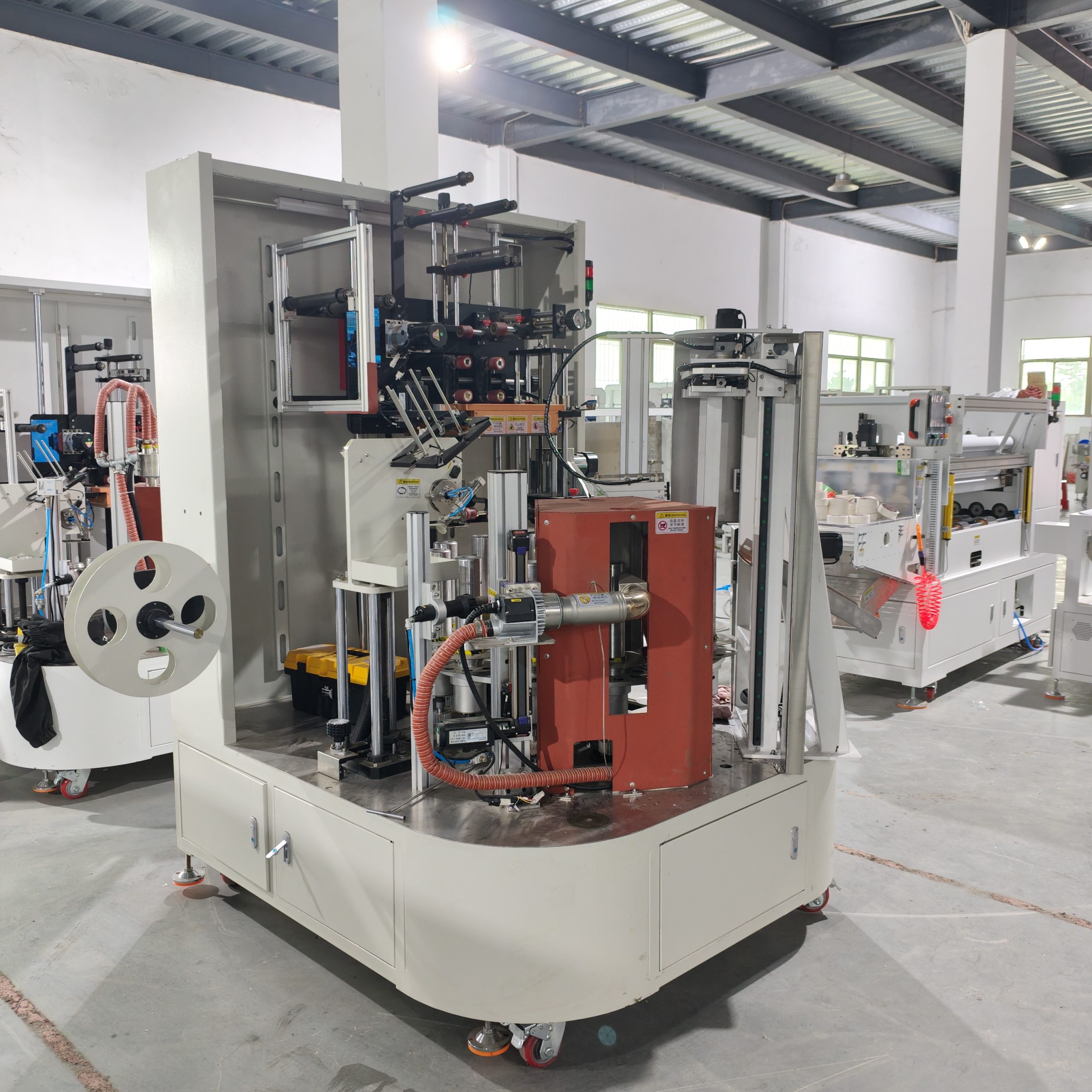

A bare PVC electrical tape roll does not travel well. Edges pick up dust, the outer wrap loosens, and by the time the pallet reaches a distributor the rolls look older than they are. Rejects follow, and that cost lands on the converter.
Wrapping each roll in film with a printed card or printed sleeve fixes the presentation, but only if the wrapping step keeps up with the rewinding line feeding it. That is the real decision behind an electrical tape packaging machine purchase: how much of the packing cycle you still want a human hand inside.
What Is an Electrical Tape Packaging Machine?
It sleeves a finished roll, or a stack of rolls, in heat-shrink film and passes it through heat so the film pulls tight. Most lines add a paper card insert or a printed sleeve, which puts a barcode, a brand panel and a tamper-evident seal on every unit.
It replaces two things:
- Cardboard cartons cost more per roll and add volume to every shipment.
- Hand sleeving with a heat gun costs nothing in capital and varies with the operator, and that variance shows up as wrinkled seams and rework.
Types of Electrical Tape Packaging Machines
Three tiers cover most electrical tape plants. The tier you buy decides how much labour stays in the cycle.
SD-60SS: Fully Automatic Single-Roll Wrapping
Best for: PVC electrical tape on small cores, one roll per pack, in repeat volumes.
Core difference: the roll feeds itself. An operator supervises rather than loads, and the machine is rated 0–65 rolls/min.
What supports it:
- Programmable micro-computer control through a man-machine interface
- Servo drive
- Turntable structure that keeps the footprint small
- Mechanical hand that places the paper card
- Constant and adjustable temperature control
- Faults raise an alarm with one-key recovery
Choose this when your electrical tape runs on 38–42 mm cores and single-roll packs are your standard format. Core inner diameter is the hard gate.
Full specification: SD-60SS single electrical tape automatic packaging machine.
SD-920HM: Semi-Automatic, Operator Loads, Machine Finishes
Best for: order mixes that change weekly. Different diameters, different roll heights, sometimes single rolls, sometimes multipacks.
Core difference: a person places the roll or stack, then the machine sleeves, shrinks and discharges it through the automatic manipulator. Throughput runs 0–50 packs/min, and since one pack can hold several rolls, packs/min is not the same number as rolls/min. Size on rolls, not packs.
What supports it:
- Covers 76 mm core tape as its main format, also runs 56 mm and 38 mm, swapping the mold per diameter
- Roll height built to your requirement
- Colour film and transparent film open independently
- Paper card fed automatically
- Stops itself on a fault alarm
- Wireless remote APP monitoring and remote system upgrade
Choose this when your product list is not stable enough to justify a dedicated single-roll machine. Of our two sleeve-film machines, this one packs better.
See the SD-920HM semi-auto film heat shrink packaging machine.
SD-TB1020: Fully Automatic Multipack Wrapping
Best for: converters shipping bundled multipacks, the towel pack format some markets call a cuff pack.
Core difference: automatic material detection and running, with an adjustable pusher so bundle sizes feed cleanly. One button switches between full-automatic and semi-automatic running, useful when you are short-staffed or training someone.
What supports it:
- PLC control with a human-machine interface
- Adjustable constant-temperature control
- Low energy consumption
Choose this when volume justifies full automation and your customers buy bundles. It handles multipacks only. If your book includes single-roll packs, this is not the machine for them.
Details: SD-TB1020 fully automatic towel pack machine.
Where It Fits on the Line
Paper core preparation comes first: a paper core cutting machine cuts cores to the widths your rewinders need, then rewinding and slitting turn jumbo rolls into finished rolls.
Packaging starts after that: single-roll or multi-roll shrink wrapping (SD-60SS, SD-920HM, SD-TB1020), then column sleeve shrinking if you ship stacked columns, then labeling, case erecting and sealing, and palletizing.
Packaging is where most plants find their bottleneck. Rewinding capacity they already understand. Wrapping capacity is the number few buyers measure before asking for quotes.
Automatic vs Semi-Automatic: What Actually Changes
Five things move when you change tiers.
Labour per Shift
A semi-automatic machine needs hands at every cycle. That is the trade: you buy flexibility and pay for it in labour.
A Malaysian customer who replaced hand-packing with automated shrink wrapping reported:
- 20% higher output
- 30% lower labour cost
- 19% fewer rejects
All measured against their own manual baseline. Those numbers came from moving off hands entirely, not from switching machine tiers.
Pack Consistency
Mechanical feed puts the seam in the same place every time. A tired operator does not. If the brand panel has to sit square on the shelf, automation buys something training cannot.
Format Range
SD-60SS is built around 38–42 mm cores.
SD-920HM covers 76 mm first and drops to 56 mm and 38 mm.
SD-TB1020 runs multipacks.
Match the machine to what you ship, not what you might ship one day.
Changeover
Diameters on SD-920HM mean a mold swap. Parameters on SD-60SS are entered on the interface. Bundle sizes on SD-TB1020 move with the pusher.
Rarely modelled in quotes, so cost it yourself: every change is stop, unload, rethread, re-establish temperature, then scrap the first few packs.
Capital
Semi-automatic costs less to buy for similar floor space. The honest comparison is annual cost, not invoice price.
The Crossover Point
Once one operator packs roughly 600–800 single rolls per shift, the yearly labour behind those rolls tends to sit in the same order as the yearly cost of owning an automatic machine.
Below that, semi-automatic usually pays back slower than buyers expect. Test it against your own wage rate, since labour differs more between countries than machine prices do.
Not sure which side of the crossover you are on? Send us your rolls per shift and we will run the math.
How to Choose the Right Electrical Tape Packaging Machine
Six steps settle the technical fit.
1. Measure Core Inner Diameter First
38–42 mm single rolls point to SD-60SS. 76 mm, or a mix of 76/56/38, points to SD-920HM. Nothing else gets decided until this number is on the table.
2. Count Rolls per Shift and per Day
Actual shipped volume including the seasonal dip. A machine sized for your best month idles the rest of the year.
3. Decide What Leaves Your Factory
Single rolls go to SD-60SS or SD-920HM. Towel multipacks go to SD-TB1020 or SD-920HM. Do not buy a multipack machine for a single-roll order book.
4. Fix Your Film and Insert Strategy
Printed film, clear film with a card, or both. SD-920HM opens colour and transparent film independently; SD-60SS feeds cards with a mechanical hand. This drives consumable cost per roll.
5. List Your Roll Heights and Diameters
SD-920HM takes one mold per diameter and its height is built to order. Get the list right before the machine is built.
6. Walk the Floor
Where the machine sits, where the operator stands, where packs stack. Footprints are compact; discharge and cartoning still need room.
Those six settle the technical fit. The next list settles the commercial side.
Questions to Ask Before You Sign
1. Who Pays for Installation Travel?
If the answer is you, and the engineer stays two weeks, get it in writing. Video-guided remote installation should mean assembly the day the machine arrives and production after one to three days of commissioning.
2. Is CE Documentation Included, and Is Guarding Standard or Optional?
For European shipments, CE certification and light-curtain guarding are not add-ons you buy later. Ask if they sit in the base scope.
3. What Is the Real Service Life Under Two-Shift Running?
Marketing answers are worthless. Ask for reference machines you can call. Our machines have passed seven years under two-shift production, and we keep customer feedback from several countries on file to back it.
4. Can Someone Diagnose Remotely, or Does Everything Wait for a Flight?
Remote monitoring and remote system upgrades cut days out of most stoppages. Ask what the supplier can see from their side.
5. What Happens When I Change Core ID or Roll Height in Two Years?
The answer should be concrete: swap the mold, re-spec the fixture, rebuild the feed. “We will see” means you bought a machine with an expiry date.
6. Which Wearing Parts Should I Stock, and What Is the Lead Time?
Blades, heaters, suction cups, sensors. A machine waiting three weeks for a cheap part is an expensive machine.
These are the standards we build to at Shengde. Compare any quote against that list, ours included.
FAQ
How much does an electrical tape packaging machine cost?
It depends on format, core range and whether you need automatic feeding. Send your roll specifications and we will return a sized quote. We do not quote numbers off a description, because every one of them changes the machine.
What film gauge should I run?
Most tape shrink film falls in the 15–25 micron band, thicker on large multipacks that get handled roughly. Confirm against your sleeve dimensions with your film supplier, since shrink ratio varies by grade.
Do I need a separate shrink tunnel?
Single-roll and multipack wrappers carry their own heat source. A separate tunnel belongs to the column-packaging stage further down, where whole stacks are sleeved together. Ship individual packets and you do not need one.
Can I start semi-automatic and upgrade to automatic later?
No. Automation level is designed in, not bolted on. If you expect automatic volumes within two years, either buy automatic now or budget for a second machine and treat the first as your backup for odd formats.
Before You Ask for a Quote
Send four numbers:
- Core inner diameter
- Finished roll width and diameter
- Rolls per shift
- Your film and insert choice
We return a one-page sizing recommendation showing which machine fits and why, with no quote attached unless you ask for one. It takes the guesswork out of the tier decision before money enters the conversation.
If you already know what you need, request a quote from Shantou Shengde for an electrical tape packaging line sized to your plant, and we will include the changeover plan and installation schedule with it.
