
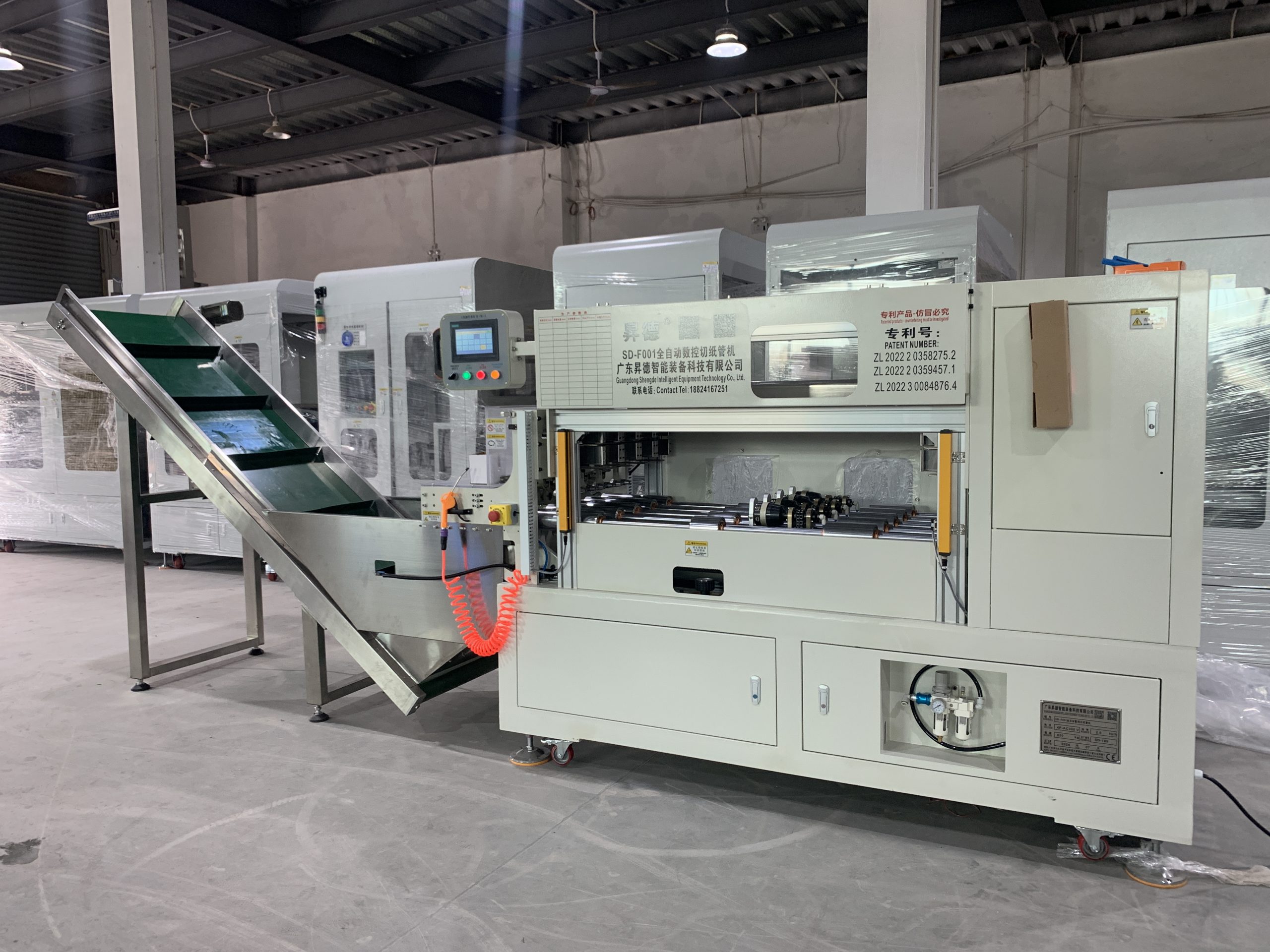

Most tape that comes back from a distributor does not come back because of the adhesive. It comes back because of the core. A core cut 2 mm short leaves a gap on the shaft, the roll drifts sideways while it winds, and by the time the pallet reaches the customer the edges have walked. A core with a rough or out-of-square end lets the roll telescope inside the carton. Nobody files a claim against the adhesive supplier for that.
Core cutting is the first station in a tape plant, and it quietly sets the tolerance budget for every station after it. This guide covers what a paper core cutting machine does, the specifications that actually decide your rolling quality, where the machine sits on the line, and how to work out whether cutting in-house beats buying pre-cut cores.
What a Paper Core Cutting Machine Does
A paper core cutting machine takes long paper tubes from the tube winder and cuts them into the exact lengths your winding shafts need.
It is worth being precise about the scope, because buyers get this wrong often enough that we say it in every quote. An automatic paper core cutter cuts paper cores only. It does not cut tape. Finished tape widths are cut after rewinding, on a log cutter, which is a different machine on a different station. A supplier who tells you one machine does both is selling you a project that fails at the commissioning stage.
There is a second job the machine does that rarely makes it into the brochure. Finished cores leave in an orderly queue, so the cutter doubles as an automatic core loading station ahead of the slitting machine. The operator pushes cores straight onto the winding shaft instead of counting them out of a bin. On two-shift production that handoff saves at least 10 minutes on every shaft change, and shaft changes are the clock that the rest of the plant runs on.
Specifications That Decide Your Rolling Quality
Four numbers matter more than the rest.
Core inner diameter. The standard machine handles 76 mm (3 inch), which covers most of the tape industry. 38 mm cores are also common on smaller formats. Confirm which one your winding shafts take, because the mandrel set is built around it.
Wall thickness. 1 to 9 mm, which covers both thin-wall tubes and thick reinforced ones. Wall thickness drives blade load far more than inner diameter does, which is why a machine that cuts 2 mm tubes cleanly can struggle on 8 mm board stock if the frame and clamping were undersized.
Cut length range. 10 to 90 mm as standard, covering narrow cores through conventional large cores. Lengths outside that band are available on request. What matters more than the range is repeatability inside it: on a full shaft of cores, the length variation across the stack is what decides whether your slit rolls come off with square ends.
Small-format quality. Short cores are where most machines fail. Below about 15 mm the tube wants to collapse under the blade, and a crushed lip on the end shows up as an off-centre roll thirty metres downstream. The SD-F001 holds 12 mm cores round and clean, which is a clamping and feeding problem rather than a blade problem.
You can read the full specification breakdown on the SD-F001 four-axis automatic paper pipe cutter page.
Fully Automatic vs Semi-Automatic Core Cutting
| Aspect | Traditional semi-automatic | Fully automatic (SD-F001) |
|---|---|---|
| Blade exposure | Blade open; operator feeds and removes tubes by hand next to the cutting zone | Fully enclosed guarding with light curtain; blade not exposed |
| Spec change | Manual stop and repositioning, 30 minutes or more of downtime | Length entered on the touchscreen, about 1 minute |
| Short cores (12 mm) | Tube crushes and deforms, collapsed ends cause rewinding faults | Patented clamping and feeding keeps ends round |
| Output | Capped by the operator’s rhythm; running faster raises error and waste | Continuous feed, precision length cut, ordered discharge |
| Head and tail | Cut and mixed back into the batch | Automatically excluded |
The four differences above are the ones tape plants feel every shift: safety, changeover speed, small-core quality, and output. They are also the four points where a semi-automatic machine quietly costs more than it saves.
Where Core Cutting Sits on the Line
Two layouts are common, and the core cutter plays a slightly different role in each.
High-meterage OPP tape. The cutter produces cores matched to the jumbo shaft length, and those cores load onto the slitting machine. Here the cores are long, and length consistency across the full shaft is what decides whether the slit rolls have square ends.
Mixed industrial tapes. Core cutter, then a rewinder, then a log cutter. In this route core wall thickness feeds straight into the log cutter’s blade load, so end squareness and wall uniformity matter even more.
Downstream of both layouts, the packaging end of the plant assumes a roll that stands straight: single-roll shrink wrapping on the SD-60SS electrical tape packing machine, folded-corner packing on the SD-65MB line, or column sleeve packing on the SD-1060 + SD-4520 sleeve film line, then case packing and palletising. Every one of those stations is sized around a consistent roll diameter and a square edge. Straightness starts at the core, which is why we treat this machine as a quality station rather than a preparatory one. If you want the packaging side in detail, our guide to how to choose the right tape packaging machine covers the formats and what each one expects from the roll.
In-House Core Cutting or Buying Pre-Cut
| Aspect | Cutting in-house | Buying pre-cut |
|---|---|---|
| Spec flexibility | Any length, one-touch changeover, same-day response | Limited to the supplier’s stocked sizes |
| New length lead time | Minutes | Days to weeks, usually with a minimum order quantity |
| Unit cost at volume | Tube cost only, no cutting margin | Includes the supplier’s cutting margin |
| Quality control | Checked in-line, defects rejected at the machine | Inspected after delivery, problems found late |
| Fits best | Multi-spec plants, custom widths, growing SKU count | One or two stable specs with reliable supply |
Our advice is blunt. If you run three or more core lengths, or you regularly quote custom widths, in-house cutting pays for itself and shortens your delivery promise at the same time. If you run one standard spec with a dependable local tube supplier, buying pre-cut is defensible. Either way, do not buy a core cutter to fill a space on a line drawing.
Why Core Quality Shows Up at the Wrapping Station
This is the part most buyers only understand after a complaint.
Shrink wrapping, folded-corner packing and column sleeve packing all rely on the roll being a predictable cylinder. The film shrinks at a set rate around a set diameter, and the tunnel settings that produce a clean wrap on a 76 mm roll will wrinkle on the same roll if the diameter runs 2 mm over.
An off-centre core is the usual cause. When the core is not concentric with the roll body, the finished roll runs slightly oval. The wrapper’s mould, the paper card, and the sleeve all assume a round product. An oval roll sits crooked in the mould, the card skews, and the shrink film tightens unevenly, which the customer sees as a wrinkled or lopsided pack. The operator then adjusts tunnel temperature trying to fix a problem that began three stations upstream.
The same applies to length. Cores cut short leave the roll loose on the shaft, the winding tension varies across the width of the roll, and the finished roll is not flat. A roll that is not flat stacks badly, and badly stacked rolls distort inside the shrink pack during transport. That is how a perfectly good wrapper ends up blamed for a core tolerance problem.
Before you turn the tunnel temperature up to compensate for a roll problem, work back to the core. What the wrapper actually expects from the roll is set out in our guide to heat shrink packaging machines for tape.
Our maintenance guide covers the other half of this picture, including what to check on the wrapper itself: how to save money on tape packing machine maintenance.
How to Choose a Paper Core Cutting Machine
- Write down core ID, OD and wall thickness before anything else. 76 mm and 38 mm IDs cover most plants, but wall thickness drives blade load and end quality more than ID does. Send the supplier a sample tube, not a drawing.
- State your shortest and longest length, then ask about repeatability inside that range. Narrow cores can run as short as 10 to 12 mm. Length consistency across a full shaft matters more than the top speed on the spec sheet.
- Ask what the cut ends look like, not how fast the machine runs. Uneven ends and crushed lips are the direct cause of telescoping downstream. A machine that cuts fast and leaves a burr is not faster in practice.
- Confirm dust extraction at the blade. Paper cutting makes dust, and dust on adhesive becomes a customer complaint. Dust extraction is not an accessory on this station.
- Size the machine to your real demand. Work backwards: rolls per shift divided by cores per roll gives cores needed per shift. Add headroom to that number instead of matching a peak figure.
- Settle guard and certification before you talk freight. CE certification and light-curtain guarding are mandatory for Europe. Confirm them in the quote rather than discovering them at the customs stage.
If your line includes slitting and rewinding, the tolerances on the upstream side are covered in our guide to tape slitting and rewinding machines. For the wider equipment comparison, see comparing tape packing machines.
Why Shengde
We build equipment that stays in production. Our SD-series machines are still running on two-shift duty after seven years without a rebuild, and the core cutter inherits that build standard. The SD-F001 has held a national patent since 2022 and sells over 100 units a year to tape plants at home and abroad.
Installation is video-guided and remote. The machine is typically rigged and running the day it is uncrated, with one to three days of commissioning before full production. No waiting weeks for an engineer’s visa, no travel and accommodation billed on top of the machine price. For a first-time buyer building a new line, that start-up speed usually matters more than a small gap in the quote.
FAQ
Can the core cutting machine also cut tape?
No. The machine cuts paper cores only. Finished tape widths are cut after rewinding, on a separate log cutter. They are two stations with two machines, and a supplier who claims otherwise is setting up a commissioning failure.
I buy pre-cut cores today. Is a core cutter worth it?
Count your core lengths. At two or fewer stable widths, stay with pre-cut. At three or more, or if you often quote custom widths, in-house cutting removes supplier lead time from your delivery promise and lets you accept an order on Monday and ship it that week. That responsiveness is what most of our customers actually buy.
What length tolerance can we expect across a full shaft?
It depends on tube quality, wall thickness and the clamping setup, so we size it against your actual cores rather than quoting a single number. Send your tube sample, your shortest and longest lengths, and the number of cores per shaft, and we will tell you what the machine holds on that mix.
How long does installation and training take?
Setup is normally done the day the machine arrives, followed by one to three days of commissioning and operator training by video. We stay on the call through the first production run and keep the same channel open for blade changes and adjustments later.
Next Step
Send us your core dimensions (inner diameter, wall thickness, length range), your tape widths, and your rolls per shift. We will size a core cutting solution to those numbers and tell you honestly if your existing tube supply makes the machine unnecessary.
Shantou Shengde Machinery
