
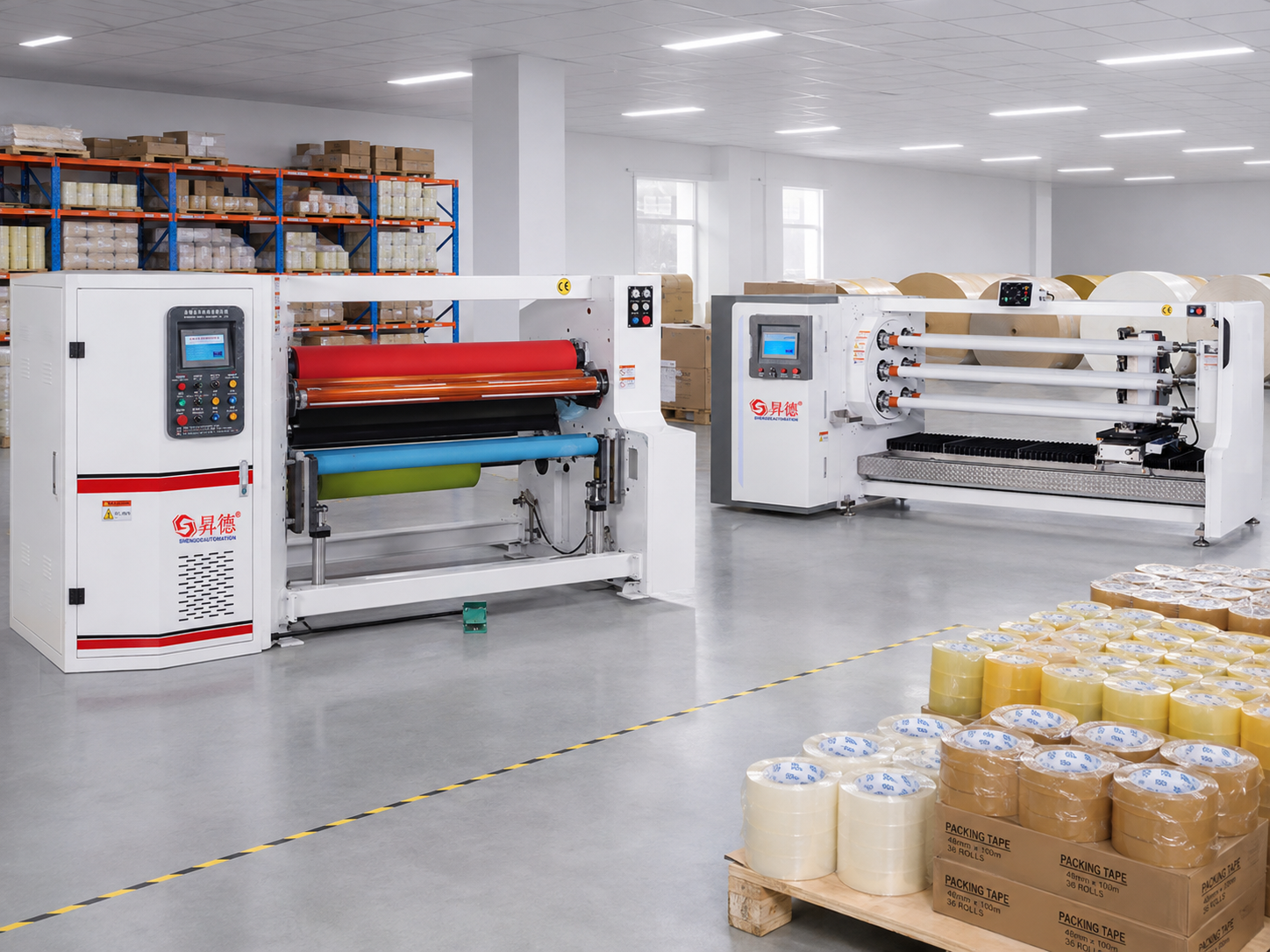

Tape Slitting and Rewinding Machines: A Practical Guide for Tape Converters
A converter’s margin is decided at the slitting line, not at the checkout. The mother roll is cheap material; the finished roll is what your distributor pays for and what clears customs. If the slitter-rewinder drifts by half a millimeter, every unit downstream carries that defect: the carton, the label, the pallet, all built on a roll that does not measure up. This guide covers the two real process routes converters actually run, the models that fit each, and how to pick the route that matches your product mix. We are not comparing knife geometries first. The route architecture is the decision that matters.
What Is a Tape Slitting and Rewinding Machine?
It takes a wide jumbo roll of coated tape and turns it into finished rolls at the width and length your customer ordered. Slitting scores the web into lanes; rewinding re-packages each lane onto a paper core at controlled tension. The machine sets three things your buyer feels: edge straightness, roll roundness, and how fast you can change over between products. A converter lives on those three numbers.
Two Routes: Rewind-Then-Cut vs One-Pass Slitter-Rewinder
Most buying mistakes start here. Engineers reach for “razor vs rotary blade” as the first question. That is the wrong first question. The first question is whether you run two machines or one.
Route 1: Rewinder + tape cutting machine (two machines)
The mother roll goes to a rewinder, which winds it to the required length. Then a cutting machine scores it into final widths. Equipment on this route: the SD-201F double-shaft rewinder plus a tape cutting machine such as the SD-710 10-axis cutter.
This route fits OPP, masking, cloth, warning, and foil tape. Multiple types, short to medium roll lengths, multi-variety and small batch. Flexibility is high and changeover is fast. The real weakness is long rolls: the cutting blade heats up during sustained long cuts and the web breaks, dropping yield. Route 1 is not built for long-roll production.
Route 2: Slitter-rewinder (one machine)
The mother roll enters a single machine that slits width and controls length in one pass, then drops finished rolls. This route fits one thing well: standard OPP in long rolls, single variety, large batch. Long rolls are its strength: edges stay clean, the web stays stable, no overheating bottleneck at the cut. The weakness is material compatibility. Non-OPP tapes fight the machine, and changeover between products is complex and slow.
The decision is blunt. Converting several industrial tape types at short to medium lengths: take Route 1. Running long OPP rolls in a narrow product range: take Route 2. Do not buy a slitter-rewinder for a multi-type plant, and do not run long rolls through a cutting machine.
Real models we build for these routes:
| Route | Model | Configuration | Web width / Speed | Best for |
|---|---|---|---|---|
| Route 1 | SD-201F rewinder | servo double-shaft | 1300 mm / 120 m/min | multi-type, short to medium rolls |
| Route 1 | SD-710 cutter | 10-axis (5+5 standby) | 34 knives/min | fast changeover, small batch |
| Route 2 | slitter-rewinder | one-pass | long-roll OPP | single-variety large batch |
- SD-201F servo double-shaft rewinder, 1300 mm web width, 120 m/min. This is the recommended main rewinder for Route 1.
- SD-101F double-shaft exchange rewinder with non-stop shaft change, which removes the reload wait between sets.
- SD-710 10-axis tape cutting machine, 5-cut-5-standby configuration, 34 knives per minute. Smaller footprints: SD-708 (8-axis), SD-706 (6-axis), SD-704A/B (4-axis).
Where Slitting Fits on a Tape Line
Slitting is not a standalone station. On a tape plant the flow is:
Mother roll (coating) → slitting (Route 1 or Route 2) → packaging (shrink film or carton, typically an SD-77HM heat shrink packaging machine) → labeling (SD-200 side-labeling machine) → case packing (SD-KFX600) → palletizing (SD-30KGA).
Slitting sets the final size and quality of every roll. Its precision propagates to every shipping unit. A bad slit means relabel, repack, rework, or reject at the end of the line, where correction costs the most. That is why the rewinder and cutter are sized to the whole line’s peak, not to one station’s average.
Slitting In-House vs Buying Pre-Slit Mother Rolls
A second real option is to skip the machine and buy pre-slit rolls from a supplier.
Slitting in-house gives you control of width and length, protects your coating formula, and lets you answer a small custom order in days. The cost is capital, floor space, and an operator.
Buying pre-slit rolls removes the machine, but you pay a per-roll premium, lose flexibility on width, and depend on your supplier’s lead time for every custom order.
The math is simple. If you run more than a few widths or change products weekly, in-house pays back fast. If you sell one standard OPP width at high volume and never take custom orders, pre-slit may be enough. Most converters outgrow pre-slit within a year.
How to Choose the Right Tape Slitting Rewinding Machine
1. Map your product mix before you read a spec sheet. Multiple tape types, short to medium lengths: Route 1. Long OPP only, narrow range: Route 2. The mix decides the route; the route decides the machine.
2. Size web width and speed to peak, not average. The SD-201F handles 1300 mm at 120 m/min. Rate your line at about 60% of peak demand so changeovers do not stall production.
3. Demand closed-loop tension control. Tension prevents telescoping. A telescoped roll cannot ship. Ask for closed-loop tension, not a friction brake that drifts as the roll builds.
4. Count changeover minutes. Double-shaft exchange (SD-101F) or 5-cut-5-standby (SD-710) removes the reload wait. Multiply minutes saved by your daily changeovers; that is real output, not a brochure number.
5. Check the blade and the cooling. A clean edge comes from a good blade plus stable cutting accuracy, not from raw speed. For long rolls, inspect the machine’s cooling design. Overheating is the main cause of web break on sustained cuts.
6. Confirm export compliance up front. CE certification and light-curtain guarding are non-negotiable on an export line. Confirm them before you quote freight, or your operators and your customs paperwork both take the hit.
Why Shengde
We build lines that stay running. Our slitting and rewinding equipment is proven under two-shift production for 7 years without a rebuild. Installation is video-guided remote: we stand your line up the same day, then 1 to 3 days of commissioning and you are in production. No expensive overseas trip, lower total cost of ownership, line online fast. Export builds ship with CE certification and light-curtain guarding, so your operators are protected and your customs entry is clean.
FAQ
Q: We convert OPP, masking, and cloth tape. Which route?
A: Route 1, rewinder plus tape cutting machine. Compatibility is wide and changeover is quick. A one-pass slitter-rewinder will fight you on non-OPP materials and cost you yield.
Q: We only make long OPP rolls. Is Route 1 wrong for us?
A: For long rolls, Route 1’s cutting machine overheats the blade and breaks the web. Take Route 2, a slitter-rewinder, for stable long-run OPP. Match the route to the roll, not the other way around.
Q: How long until we are actually producing?
A: Video-guided remote installation: line stood up the same day, 1 to 3 days of commissioning, then full production. Not weeks of on-site service.
Q: How do we stop telescoping on the finished roll?
A: Use closed-loop tension control, not a friction brake that drifts as the roll builds. Stable tension keeps the edges square so the roll ships instead of telescoping onto the pallet.
Q: What export compliance do we need on the slitting line?
A: CE certification and light-curtain guarding are non-negotiable on an export line. Confirm them before you quote freight, or your operators and your customs paperwork both take the hit.
Conclusion
Pick the route by your product mix, not by a spec sheet. Tell us your tape types, widths, and daily volume, and Shantou Shengde will size a slitting and rewinding line to your plant.
Related machines
For the packaging step downstream of slitting, see the SD-77HM heat shrink packaging machine and the SD-F001 paper core cutter. For the labeli
