
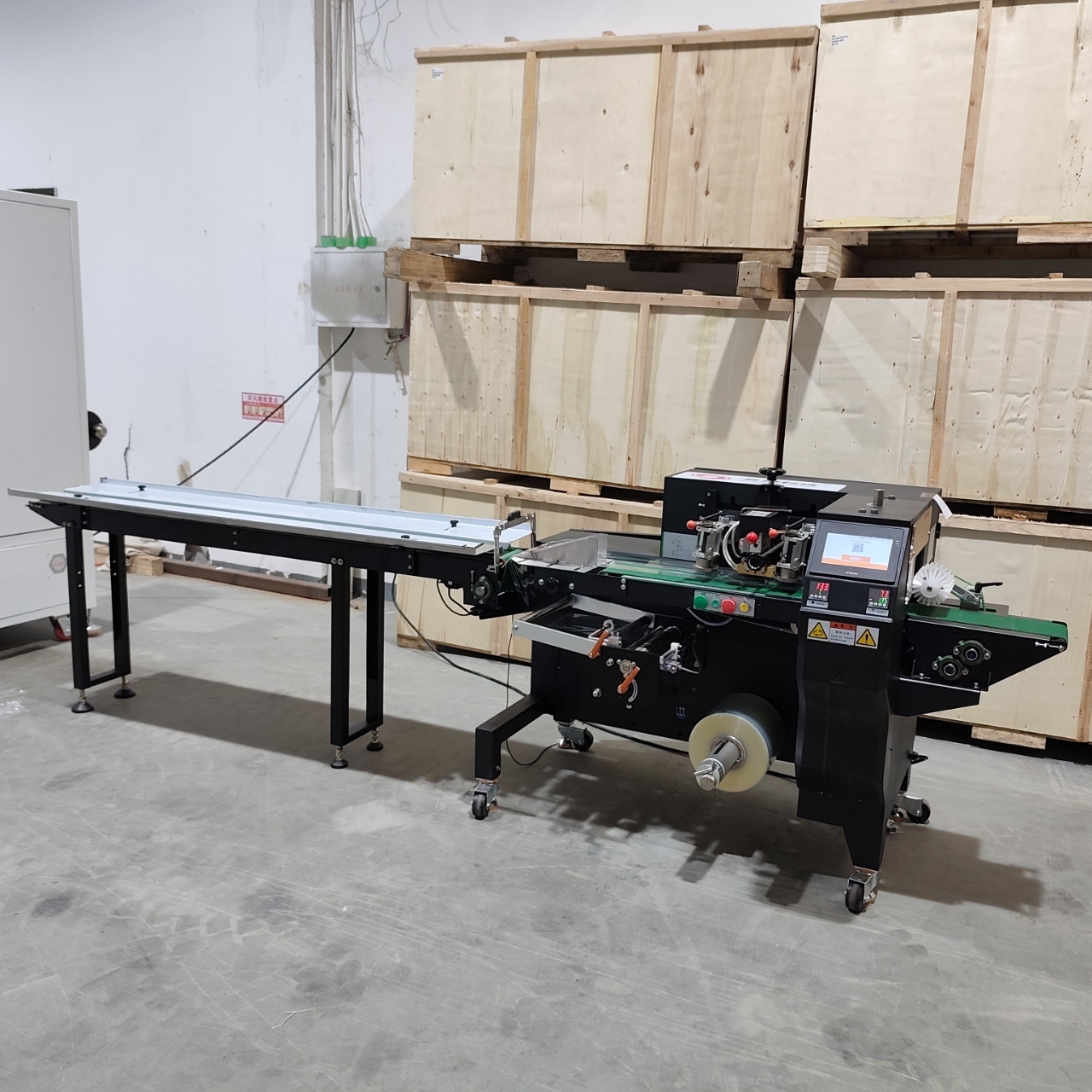

Flow Packing Machine Setup for Tape: Bag Length, Film Tension, Seal Temperature
A flow packing machine rarely fails loudly. It fails in film waste, unsealed bags, and a line that stops every twenty minutes because a bag came out short. The three settings that decide quality — bag length, film tension, seal temperature — are adjustable, and once set, the machine runs the same way every shift. This article covers what each setting does and how to choose the right wrapper.
What a Flow Packing Machine Does for Tape and Hardware
A horizontal flow packer pulls a flat film web around the product, seals it underneath, and cuts each bag to length. For tape and hardware it produces a tight pillow pack instead of a loose sleeve. The machine stores product recipes, so once a roll size is saved, the next changeover is a menu selection, not a mechanical rebuild.
The SD-350 horizontal flow packer runs on three servos with a touch screen. Recipes are stored and reusable, bag length adjusts automatically, and seal and cut positions stay accurate across the run — so one machine packs uniform tape rolls and varied hardware alike.
The Three Settings That Decide Package Quality
Bag length
Bag length must clear the product plus the seal allowance at both ends. Too short and the seal clips the roll; too long and you waste film on every bag. On a recipe-driven machine, set the length once per product and let the servo hold it. The check: measure ten finished bags. If length varies by more than a millimeter or two, the film feed or product push timing is drifting and needs correction before a full shift.
Film tension
Tension pulls the film tight around the roll as the tube forms. Too loose and the bag wrinkles; too tight and the film stretches, then relaxes after sealing and the pack looks baggy. The right tension holds the film snug without dragging the product, and keeps the printed face aligned on tape rolls.
Seal temperature
The seal bar melts the film layers together. Too low and the seam opens when handled; too high and the film burns or sticks to the jaw. The target temperature follows the film gauge, not the machine. Thin printed film seals lower than heavy PVC, so set the bar to the film spec and verify the first batch before committing the run.
Types of Flow Wrappers
SD-350: Horizontal Flow Packer with Stored Recipes
Best for: tape rolls, small hardware, and mixed solid items that need a sealed pillow bag rather than a shrink sleeve.
Core difference: three-servo control with touch-screen recipes, so bag length and seal position are set per product and held automatically.
What supports it: automatic bag-length adjustment removes the manual setup step; accurate sealing and cutting keep reject rates low.
Choose this when: your products vary in size but you want one machine to pack them all without tool changes.
SD-77HM: Single-Roll Sleeve Shrink (the alternative route)
Best for: 76 mm core tape rolls where a shrink sleeve with a paper card is the required pack format.
Core difference: applies a film sleeve and shrinks it tight in a tunnel, a different look and a tighter secondary pack than a flow bag.
What supports it: constant-temperature control and automatic fault alarm keep the seal in range without an operator watching the bar.
Choose this when: your customer specifies shrink packaging, not a flow bag — the two formats are not interchangeable.
Where the Flow Wrapper Fits on the Line
The flow packer sits at the finishing end of a tape or hardware line, after the rolls or parts are made and before they are cased.
Roll or part formation → flow packing (SD-350) → case erecting and sealing → palletizing.
For tape, the flow packer competes with the shrink sleeve route (SD-77HM plus a tunnel). Pick the format your buyer demands, then set the machine to that format and leave it there.
Flow Wrapper vs Shrink Wrapper: Which for Your Roll
The choice is about pack format and line speed, not which machine is “better.”
Choose a flow packer when
Your product is uniform or your line mixes tape with hardware. The bag is fast to form, film cost is low, and recipes make changeover a menu pick. Good for high counts of similar items.
Choose a shrink sleeve when
Your buyer requires a tight film sleeve with a printed card, or the roll must look like a retail unit. The shrink route needs a SD-4522 tunnel and more floor space, but it gives a different shelf presentation.
If you run tape in one core size and one pack style, either works. If you run mixed products, the flow packer’s recipe system saves more changeover time.
How to Choose the Right Setup
1. Measure the product, not the guess
Bag length starts from the roll or part length plus seal allowance. Have the actual dimension before you set the machine; do not estimate from a catalog photo.
2. Match film gauge to the product
Tape and light hardware run on thin film in the 15–25 micron band. Heavier parts need thicker film so the seal holds. Pick the gauge, then set the seal temperature to it.
3. Set seal temperature to the film
Lock the bar temperature to the film spec, run ten bags, and pull them apart by hand. If the seam opens, raise the temperature in small steps until it holds.
4. Confirm bag-length repeatability
Run a short batch and measure. Stable length across ten bags means the servo and film feed are tuned. Drift means stop and correct before a full shift.
5. Plan floor space and output
A flow packer is compact, but you still need infeed and outfeed room plus a case-packing handoff. Match the machine speed to your downstream so bags do not pile up at the exit.
Questions to Ask Before You Sign
The technical fit is above. These questions settle the commercial terms, and they are the standards we build to at Shengde.
- Who sets the first recipes? Video-guided remote installation means the machine is built and running the day it arrives, with commissioning finished in 1–3 days — no expensive overseas trip.
- Does it carry CE certification and light-curtain guarding? Both are required for export and for safe operation at the seal bar.
- What happens after seven years of two-shift production? Our machines are built for two-shift schedules; ask any supplier for the same evidence.
- Can faults be cleared remotely? Wireless monitoring lets a technician see the run and resolve most alarms without a site visit.
- How do I add a new product size? On a recipe-driven machine, saving a new product is a menu entry. Confirm that before you sign so changeover stays a setting, not a rebuild.
FAQ
How long does bag length take to set?
On a recipe-driven machine, the first setup takes a few minutes per product. After that, selecting the saved recipe resets length and seal position automatically — no manual measuring on every changeover.
What film thickness works for tape?
Thin film in the 15–25 micron range covers most tape rolls and light hardware. The exact gauge follows the product weight and the seal temperature you set.
Can it run tape and hardware on the same machine?
Yes, if both fit the bag format. Save a recipe per product and switch between them. Tape rolls are uniform; hardware varies, so the recipe system is what keeps quality consistent across both.
Is a flow packer faster than a shrink sleeve line?
For uniform products, the flow packer forms and seals in one pass with no separate tunnel, so it is usually the faster, simpler cell. A Malaysian customer reported that after replacing hand-packing with automated equipment, output rose about 20%, labor cost dropped around 30%, and defect rate fell roughly 19% — measured against their own manual baseline.
Conclusion
Bag length, film tension, and seal temperature are the three settings that decide whether a flow packing machine runs clean or wastes film. Set them to the product and the film, verify the first batch, and the machine holds the same quality every shift.
Send us your product dimensions and daily output and we will size a flow packer to your line. Ready to spec a machine? Contact our team for a quote sized to your plant.
