

L Bar Sealer for Tape and Small Goods: How It Works and How to Choose
A bare tape roll leaves your factory vulnerable. It gets scuffed in transit, picks up dust on the distributor shelf, and carries no branding or tamper evidence that a buyer can read at a glance.
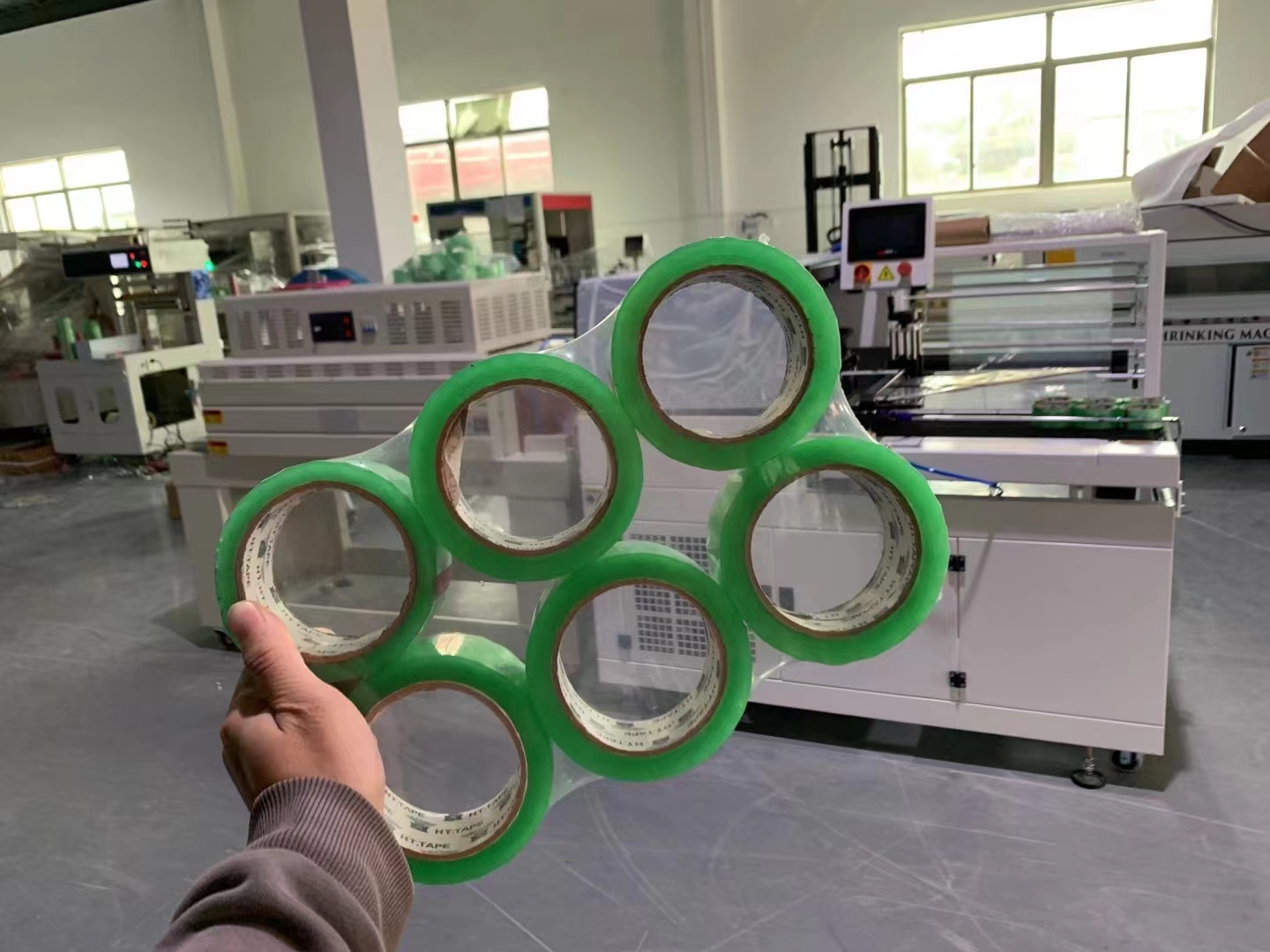
For tape converters shipping rolls plus related small goods, the L bar sealer paired with a heat shrink tunnel is the standard way to put a tight, clear film wrap on each unit without slowing the line.
This article explains what the machine does, where it sits in a tape plant, and how to choose one so you are not buying capacity you cannot use or missing capacity you need.
What Is an L-Type Sealing Machine?
An L type sealing machine closes a flat film pouch around a product using two perpendicular sealing bars shaped like an L.
The product sits on the film, the operator or an automatic feeder advances it into the seal area, and the bars clamp shut to weld three sides. The open end is then pulled through a shrink tunnel where hot air pulls the film tight against the roll or box.
The result is a single clear wrap, not a printed carton. That matters for tape because the wrap protects the roll face and edges while still showing the label and core print underneath. For mixed SKU cases, small hardware, and stationery that travel with the tape, the same sealer handles them without tooling changes.
How the L-Bar Principle Works
The L-bar sealer welds three sides of a flat film pouch, leaving the fourth side open for the tunnel.
That is why it takes roll diameters, boxed sets, and irregular shapes in the same run without a mold change: the pouch adapts to the product, not the other way around.
A sleeve wrapper is built around a specific roll diameter, which is why it cycles faster but rejects anything that does not fit the mold.
The trade-off is simple:
L-bar sealer: flexible, mixed SKU, slower per unit
Sleeve wrapper: fast, roll-only, needs a mold per diameter
Types of L-Bar Sealers for Tape Lines
SD-BL450: L-Bar Sealing With Integrated Tunnel Pairing
Best for: tape rolls, small boxes, and light hardware that need a clear protective wrap at low to medium volume.
Core difference: the SD-BL450 uses a fixed L-bar with photoelectric auto-induction, so the seal fires when the product reaches position. Sealing is firm and high-temperature resistant without membrane transfer to the film. Waste film winds automatically, and the organic glass shield opens with an alarm if someone reaches in.
What supports it:
Pairs with the SD-4522 or SD-4020 shrink tunnel on the same frame
You buy one sealing-and-shrinking cell rather than sourcing two machines
Runs on the same film grades used across the rest of the plant
Choose this when: your output is a few hundred to low thousands of wrapped units per shift and you want one operator per cell rather than a hand-wrapping station.
Heat Shrink Sleeve Wrapper as the Alternative
Best for: high-volume single or multi-roll tape where the film is a sleeve slipped over the roll, not an L-bar pouch.
Core difference: machines like the SD-77HM and SD-920HM form a shrink sleeve around the roll and add a paper card in the same cycle. They are built around the roll itself, whereas the L-bar sealer is built around the pouch.
What supports it: when the only product is tape rolls at volume, a sleeve wrapper is faster per roll and needs less film.
Choose this when: the wrap job mixes roll diameters, boxed sets, and odd shapes in the same run — the L-bar sealer wins. If the line is tape rolls only, the sleeve wrapper wins.
The Shrink Tunnel Behind the Sealer
The seal is only half the job. The tunnel decides how clean the final wrap looks and how much power it draws.
SD-4522: Energy-Saving Tunnel
Dual-frequency conversion
Stable running power about 6 kW
Insulation cotton keeps the area around the machine cooler
Higher purchase price, lower running cost
SD-4020: Economy Tunnel
Single-frequency conversion
Stable running power about 9 kW
No insulation cotton, the area around the machine feels hotter for operators
Lower purchase price, higher running cost
What the Power Gap Costs Over a Year
At two shifts (16 hours), 300 days a year, and a power rate of USD 0.10/kWh:
SD-4020: 9 kW × 16 h × 300 days × 0.10 = USD 4,320/year
SD-4522: 6 kW × 16 h × 300 days × 0.10 = USD 2,880/year
Annual saving: USD 1,440
Seven-year saving: ~USD 10,000
Choose the tunnel by budget and by how warm your floor already runs. The sealer is the same either way.
Where the L-Bar Sealer Fits on the Line
A tape roll reaches the sealer late in the process, after the converting steps that define its size:
Paper core preparation (SD-F001) → rewinding and slitting → roll packaging or heat shrink sleeve (SD-60SS, SD-77HM, SD-920HM, SD-TB1020) → column or L-bar shrink wrapping (SD-1060 plus tunnel, or SD-BL450 plus tunnel) → labeling → case erecting and sealing → palletizing.
The L-bar sealer sits at the mixed-SKU wrap point. Rolls that go out as sleeves do not pass through it. Boxed sets, sample packs, and small hardware that ship alongside the tape do.
Keeping those two streams separate is what stops the sealer from becoming a bottleneck for rolls that could wrap faster another way.
The SD-77HM and SD-920HM apply a sleeve around the roll. The SD-BL450 wraps the roll or box in a pouch. If your line ships both rolls and mixed small goods, the two streams run side by side: sleeves for the rolls, L-bar pouches for everything else.
L-Bar Sealer vs Heat Shrink Sleeve Wrapper
Pick the L-bar sealer when one cell must wrap more than rolls: a roll, a carton of rolls, a spool of dispenser, a box of clips. The pouch format absorbs shape variation that a sleeve wrapper would reject or need a mold change for.
Pick the sleeve wrapper when the line is tape rolls only and volume is the constraint. A sleeve wrapper is purpose-built for the roll, uses less film per unit, and cycles faster. Running mixed shapes through it means mold changes and stoppages.
The mistake is buying a sleeve wrapper for a line that is actually mixed, then hand-wrapping the boxes because the wrapper will not take them. That is where the L-bar cell earns its floor space.
How to Choose the Right L-Type Sealing Machine
Six points settle the technical fit. These are the dimensions to size before you ask for a quote.
1. List What Actually Leaves Your Factory
Count rolls, boxed sets, and odd shapes separately. If boxes and rolls are close in volume, the L-bar sealer is the honest choice. If rolls dominate by a wide margin, a sleeve wrapper will use less film and run faster.
2. Match the Film Grade
L-bar sealing works with POF, PVC, and PE in common shrink grades.
Light rolls and cartons typically run 15 to 25 micron POF
Heavier boxes need thicker film to hold the seal through the tunnel
The SD-BL450 handles the standard grades without a film change between product types.
3. Size the Tunnel to the Largest Face
The tunnel opening, not the sealer, limits your maximum carton. SD-4522 takes a larger tunnel cross-section than SD-4020. Measure your biggest boxed set before choosing; a tunnel that is one size too small forces you to hand-wrap the oversized jobs.
4. Count Operators, Not Just Speed
An L-bar cell with photoelectric induction runs with one operator loading and the machine sealing. At a few hundred units per shift, that is one person where hand-wrapping needed two. Above low thousands per shift, compare against a fully automatic sleeve line before committing.
5. Decide the Tunnel by Floor Heat and Power
SD-4522 at about 6 kW with insulation keeps the surrounding area cooler and costs less to run per year.
SD-4020 at about 9 kW is cheaper to buy and acceptable where the floor is already ventilated and power cost is secondary.
The sealer itself does not change between the two.
6. Plan Film Changeover as Downtime
Switching from POF to PVC or to a thicker gauge means stopping, unloading the roll, rethreading, and re-establishing tension.
Budget 10–20 minutes per change. That is where speed is quietly lost on a mixed line. Group runs by film type so each changeover is a planned stop, not a mid-batch interruption.
Not sure whether your line is mixed enough for an L-bar cell? Send us your product list and daily output.
Questions to Ask Before You Sign
The six points above settle the technical fit. These six questions settle the commercial terms, and they are the ones buyers regret skipping.
1. Who Commissions the Machine?
A video-guided remote installation puts the cell online the day it arrives, with commissioning finished in one to three days. You avoid a costly on-site trip and the wait that comes with it.
2. Does the Build Include CE Certification and Light-Curtain Guarding?
For export this is non-negotiable, not a premium option. Confirm it is in the base specification.
3. What Is the Real Service Life Under Two Shifts?
Ask for references running the machine on two-shift production. A Malaysian customer running our shrink packaging reported 20 percent more output, 30 percent lower labor cost, and 19 percent fewer defects measured against their own manual baseline after replacing hand-packing.
4. Can Faults Be Diagnosed Remotely?
Wireless monitoring and remote system upgrade turn most stoppages into a screen-share, not a service visit.
5. How Are Core Diameter and Product Height Changes Handled?
On the SD-BL450 the seal area adjusts to the product; confirm the exact range for your smallest and largest box before signing.
6. Which Wearing Parts Should I Stock?
Stock these:
Sealing bars
Heating elements
PTFE tape
Light curtain
Film guide rollers
An L-bar cell waiting three weeks for a cheap part is an expensive cell.
These are the standards we build to at Shengde.
FAQ
Do I need a separate shrink tunnel with an L-bar sealer?
Yes. The sealer welds the film; the tunnel shrinks it. The SD-BL450 is specified to pair with the SD-4522 or SD-4020 tunnel, so the two arrive as one cell. Buying the sealer without a tunnel leaves you with welded but unwrapped product.
What film thickness works for tape rolls and cartons?
Light rolls and cartons commonly use 15 to 25 micron POF. Heavier boxes need a thicker gauge to hold the seal through the tunnel without splitting. Send your largest and smallest product and we will size the film, not guess.
Can one L-bar cell wrap both rolls and boxes?
It can, and that is the reason to choose it over a sleeve wrapper. The pouch format takes roll diameters, boxed sets, and irregular shapes in the same run without a mold change. Volume-only roll lines are better served by a sleeve wrapper.
How long does installation take?
Video-guided remote installation puts the cell in place the day it arrives. Commissioning and first stable production typically take one to three days, with no expensive engineer flying in. That assumes your air, power, and floor space were checked before the machine shipped.
Conclusion
An L type sealing machine earns its place when the wrap job is mixed, not roll-only.
Size the sealer to your product mix, pair it with the right tunnel for your floor heat and budget, and group film changeovers so speed is not lost to rethreading.
Send your roll diameters, box sizes, and units per shift and we will return a sizing recommendation sized to your plant. When you are ready to spec the cell, request a quote for the SD-BL450 with the SD-4522 or SD-4020 tunnel from Shantou Shengde.
