
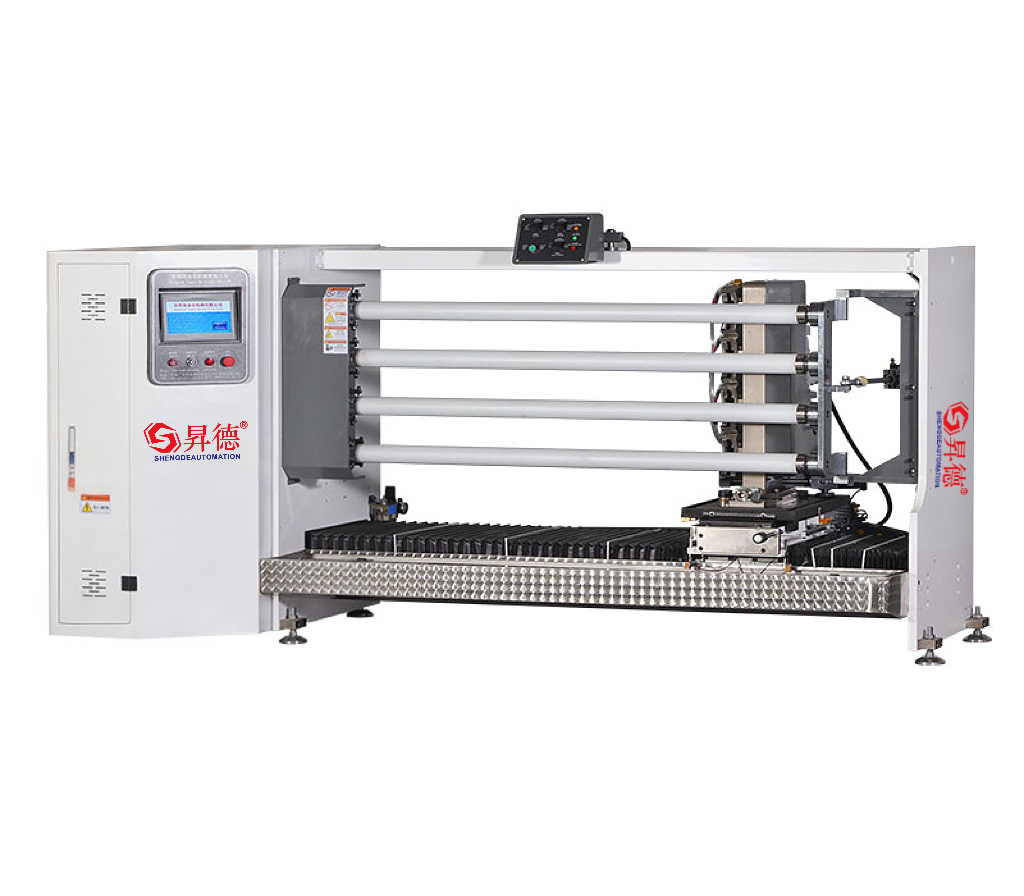

4-Axis vs 10-Axis Auto Tape Cutters: Which to Buy (Advanced)
One master log. 48 finished rolls if your cutter is sized right, 40 plus scrap if it isn’t. The axis count on your automatic tape cutter decides how many finished rolls exit each cycle, how often the machine stops to reload, and how tightly you hold width tolerance across a long run. This guide compares low-axis machines (4 stations) against high-axis buffer systems (6, 8, 10 stations) and tells you which fits your order book.
What Is an Auto Tape Cutter (Log Cutter)?
A tape log cutter takes a rewound master log, a full-width roll of finished tape, and slices it to the final selling width. It is the last shaping step before packaging. A manual bench cutter makes you position each blade by hand. An automatic cutter spaces blades from a stored program, clamps the log, and slices the full set in one pass. Output goes straight to shrink wrapping or carton packing. The cutter does not change tape quality. It decides batch size, edge quality, and how much labor sits at the end of your line.
Types of Auto Tape Cutters by Axis Count
Axis count means the number of blades cutting in one clamp cycle. More axes equal more finished rolls per cycle, but also more stations to set up and a higher price. Our range runs from compact four-axis entry units to high-output buffer lines.
- SD-704A/B – 4-axis, entry-level. Four finished rolls per cycle. Best for narrow ranges, short runs, job shops cutting 12 to 25 mm widths. Simple to learn, fast to reconfigure. Cutting speed: 0–30 cuts per minute depending on log outer diameter.
- SD-706 – 6-axis, 3-cut-3-standby buffer. Six stations: three cut while the operator loads the next three. Cuts cycle downtime versus a straight 4-axis unit.
- SD-708 – 8-axis, 4-cut-4-standby buffer. Eight stations: four cut, four load. Output approaches continuous. For steady mid-to-high volume with limited width changes.
- SD-710 ten-axis tape cutter – 10-axis, 5-cut-5-standby buffer. Ten stations: five cut, five load. Cutting never waits for loading. At 34 cuts per minute theoretical max (real speed depends on log diameter), the top-tier choice for high-volume, single-width production.
Speed note: All models run 0–30 cuts per minute in real conditions. A larger log diameter cuts slower, because the blade traverses a thicker log. Size your axis count from typical log diameter and target throughput, not from theoretical maximums.
Low-axis lines win on changeover speed. High-axis buffer lines win on steady long runs. Pick the axis count from your order book.
Where the Log Cutter Fits on a Tape Production Line
In a converting plant the cutter is not a standalone box. Trace the real flow: paper core cutting (SD-F001) feeds the rewinder; master tape is slit and rewound to length on an SD-201F dual-shaft rewinder; the log cutter slices that log to final width; finished rolls move to shrink wrapping on the SD-77HM heat shrink packaging machine, or SD-800 and SD-60SS; from there labeling (SD-200/SD-300), case packing (SD-KFX600), palletizing (SD-30KGA).
The cutter is the handoff point between rewinding and packaging. If it runs slower than the rewinder, logs stack up. If slower than the wrapper, the wrapper starves. Match its effective output to the next step, not the previous one. It also sets the quality gate: every width reject here travels through shrink, label, and case pack before anyone catches it.
Low-Axis (4) vs High-Axis (6/8/10 Buffer): Which to Buy
| Factor | 4-Axis | 6-Axis (3+3) | 8-Axis (4+4) | 10-Axis (5+5) |
|---|---|---|---|---|
| Rolls/cycle | 4 | 6 | 8 | 10 |
| Buffer | No | Yes, during cut | Yes, during cut | Yes, during cut |
| Best batch | Small, mixed | Small–medium | Medium–large | Large, single-width |
| Changeovers/shift | 5+ | 3–5 | 2–3 | 1–2 |
| Shift output | <5,000 | 5,000–8,000 | 8,000–12,000 | 12,000+ |
| Labor | Present every cycle | Reduced | Low | Minimal |
- Batch size. 4-axis for small mixed orders; 6-axis bridges the gap; 8/10-axis for one width all shift.
- Labor. Buffer lines (6/8/10) keep one operator loading during the cut. A 4-axis line needs the operator every cycle, so labor scales with volume.
- Log diameter. A 300 mm OD log cuts slower than 150 mm. Large logs may keep a 10-axis line below its theoretical throughput, but it still saves labor because loading happens during the cut.
- Width range. 4-axis handles odd widths without reprogramming many stations. High-axis pays off only when widths repeat.
- Edge quality. Axis count does not change edge quality. Tension and blade condition do.
Rule of thumb (real 0–30 cuts/min, by log diameter): under 5,000 mixed rolls/shift → 4-axis. 5,000–8,000 with variety → 6-axis. 8,000–12,000 limited widths → 8-axis. Over 12,000 single-width → 10-axis. If your log OD stays above 250 mm, de-rate these by 20–30% and size up one level.
How to Choose the Right Tape Log Cutter
1. Count finished rolls per shift. Under 5,000 → 4-axis; 5,000–8,000 → 6-axis; 8,000–12,000 → 8-axis; over 12,000 → 10-axis.
2. Measure typical log outer diameter. Larger = slower. Over 250 mm OD, de-rate 20–30% and size up one axis level.
3. Count width changes per shift. Over 4 changeovers → fewer axes. Every station added is another blade to reset.
4. Check shaft runout, not just blade count. Sloppy runout causes width drift and rejects. Ask for the runout spec in millimeters.
5. Insist on buffer design for long runs. 3+3, 4+4, or 5+5 standby means cutting never waits for loading.
6. Confirm blade cooling. Continuous cutting heats the blade; a hot blade drags tape. Check duty cycle before committing to all-day output.
7. Require CE certification and light-curtain guarding. Non-negotiable for export. The clamp closes on fingers without it.
Why Shengde
We build cutters for plants that run two shifts, not showrooms. The SD series holds 7-year reliable operation under two-shift production because the frames, shafts, and clamps are built for daily load. We offer the full range: 4-axis, 6-axis (3+3), 8-axis (4+4), 10-axis (5+5) buffer, so you get the configuration your volume and log size require. Video-guided remote installation sets it up the same day; commissioning takes one to three days on a video call, no costly on-site trip. We also calculate real-world throughput from your log OD so you never overbuy or underbuy.
FAQ
Q: How long does installation take?
A: Video-guided remote installation. Set up the same day it lands, commissioned over one to three days. No engineer flight, no two-week wait.
Q: What is the actual cutting speed?
A: 0–30 cuts per minute by log outer diameter. A 150 mm OD log cuts near the top; a 300 mm OD log much slower. We size your axis count from your real log size first.
Q: What does “3+3 buffer” mean?
A: Three stations cut while the operator loads the next three on standby. When the cut ends, the loaded rolls index in and cutting resumes with no reload downtime. Same principle at 4+4 (8-axis) and 5+5 (10-axis).
Conclusion
Axis count is a production decision, not a spec-sheet contest. Match it to your finished rolls per shift, your changeovers, and your actual log outer diameter, because real speed runs 0–30 cuts/min on that one variable. Request a quote from Shantou Shengde for a tape log cutter sized to your plant. Send your shift output target, typical log OD, and width list. We will specify the axis count and buffer that fits your order profile, not ours.
If your line also prepares its own paper cores, the upstream step is a dedicated paper pipe cutter. The SD-F001 four-axis paper pipe cutter sizes cores to the exact inner diameter your tapes need before they reach the cutting station.
