
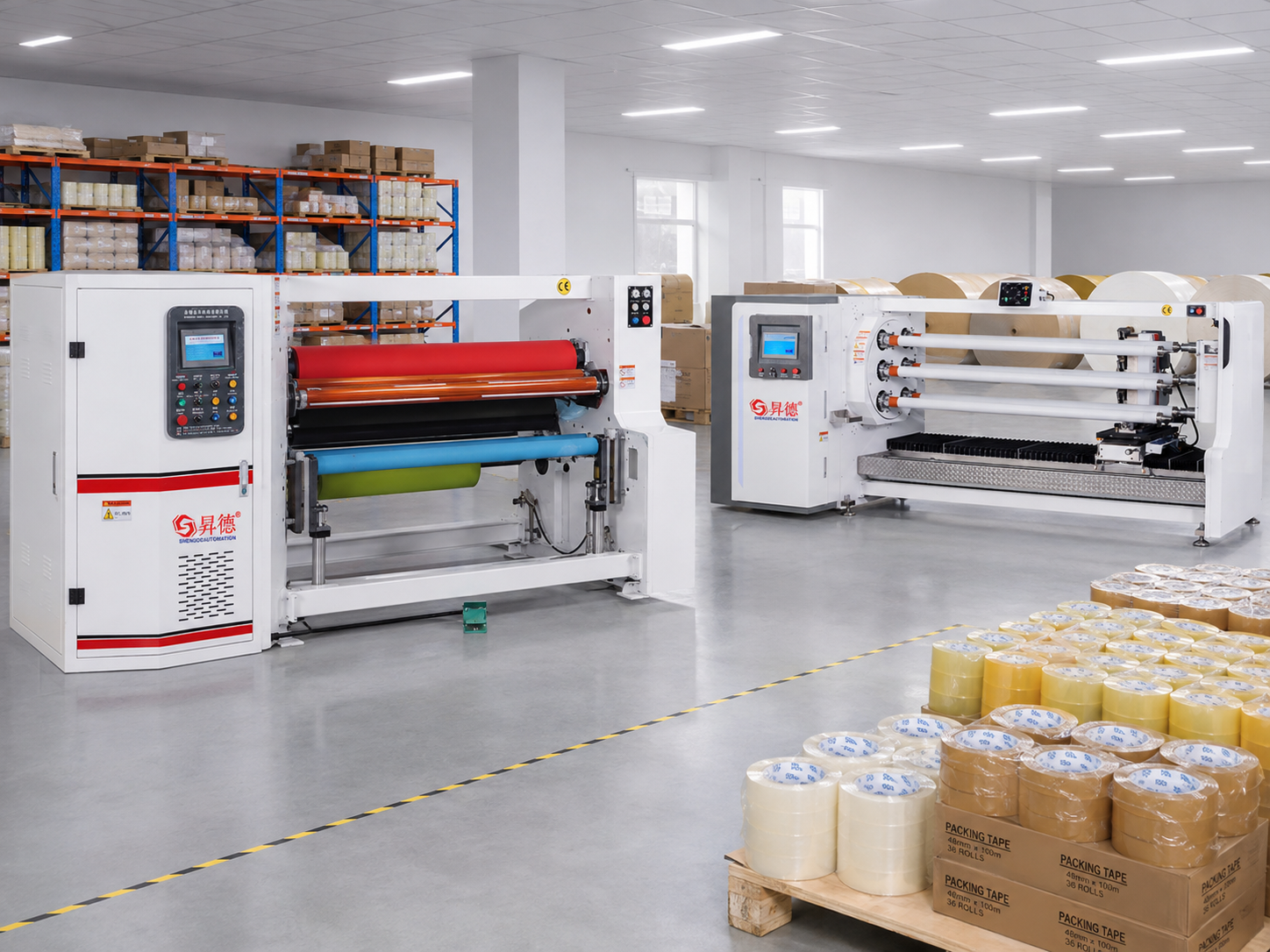

Tape Slitting and Rewinding Machines: A Practical Guide for Tape Converters
If you convert jumbo tape rolls into the widths customers buy, the slitting machine and rewinding setup determine roll quality.
This affects whether rolls run cleanly on their production line or are rejected at incoming inspection.
Poor equipment leaves fuzzy edges, loose cores, and tension variation that shows up as telescoping on the shelf.
Moreover, this guide covers two main processing routes.
It explains their pros and cons and helps you choose the right solution for your product mix.
Two Processing Routes for Tape Slitting
There are two primary ways to convert a master roll into finished retail rolls. Each suits different production needs.
Route 1: Rewind First, Then Cut (Two Machines)
Process flow: Master roll → Rewinder (rewinds to desired length) → Cutting machine (slices to final widths)
Equipment involved: Rewinder + Tape cutting machine
Advantages:
- Broad compatibility with multiple tape types, including OPP tape, masking tape, cloth tape, warning tape, aluminum foil tape, and other industrial tapes
- Flexible changeover between different materials
Disadvantages:
- Not suitable for producing long-length rolls. When cutting long rolls, the extended cutting time causes the blade to overheat, which can lead to tape breakage and lower yield
Best for: Short-to-medium length rolls, multi-variety small-batch production, factories with diverse product lines
Route 2: Slitter-Rewinder (One Machine, Direct Processing)
Process flow: Master roll → Slitter-rewinder (slits width and controls length in one pass) → Finished rolls
Equipment involved: Slitter-rewinder
Advantages:
- Stable production of long-length rolls with consistent quality and clean edges
- One-pass efficiency, ideal for high-volume runs
Disadvantages:
- Limited material compatibility; primarily suited for standard OPP tapes, with poor adaptability for masking tape, cloth tape, aluminum foil tape, etc.
- Changeover for different materials or widths is more complex and time-consuming
Best for: Long-length OPP tape, single-variety mass production, standardized product lines
How to Choose the Right Process Route
| Comparison | Route 1: Rewinder + Cutter | Route 2: Slitter-Rewinder |
|---|---|---|
| Tape types | Multiple (OPP, masking, cloth, warning, aluminum foil, etc.) | Primarily standard OPP |
| Roll length | Short to medium | Long (clear advantage) |
| Batch size | Multi-variety, small batch | Single-variety, mass production |
| Flexibility | High | Low |
| Quality on long rolls | Prone to breakage due to heat | Stable and consistent |
Summary: If your plant produces multiple types of industrial tapes in short-to-medium lengths, choose Route 1 (rewinder + cutter). If you mainly produce long-length OPP tape with a narrow product range, Route 2 (slitter-rewinder) is the more efficient choice.
Where Slitting Equipment Fits on a Tape Line
On a tape plant, the slitting operation occurs after master-roll production and before packaging.
Typically, a flow is master roll production and coating, followed by slitting, then packaging.
Moreover, the slitting machine helps define final dimensions and quality.
Precision in this step affects every unit you ship.
Key Factors Affecting Slitting Quality
- Tension control: Closed-loop tension keeps rolls tight and prevents telescoping—this is the difference between a roll you can ship and one that gets returned.
- Blade quality: Clean, straight edges come from high-quality blades and stable cutting precision, not just speed.
- Shaft runout precision: Shaft concentricity directly affects how neatly the finished rolls are wound.
- Heat dissipation (for cutting machines): When cutting long rolls, blade heating is the main cause of tape breakage—pay attention to the machine’s cooling design.
FAQ
Q: I produce multiple tape types (OPP, masking, cloth, etc.). Which equipment should I choose?
A: Route 1—the rewinder + cutter combination. This setup offers broad compatibility and flexible changeover, making it ideal for factories with diverse product lines.
Q: I only produce long-length OPP tape. Which one should I choose?
A: Route 2—the slitter-rewinder. It delivers stable quality and high efficiency for long-length OPP production.
Q: How long a roll can a cutting machine handle?
A: It depends on the machine’s design and heat dissipation capability. Long rolls generate more heat during extended cutting cycles, which can cause breakage. For long-length orders, we recommend using a slitter-rewinder.
Q: How long does installation take?
A: With video-guided remote installation, the machine can be set up on the same day, with 1–3 days of commissioning before formal production begins.
Conclusion
There is no single “best” slitting machine—only the most suitable route for your production. Choose between the “rewinder + cutter” and the “slitter-rewinder” based on your product types, roll lengths, and batch volumes—and make sure your supplier stands behind the equipment for the long run.
